

Hacking Your Machine, 1910 Style

Mac OS 7 Startup Screen

Mac OS 7 Startup Screen (via operating-system.org)

I spend way less time these days tweaking and fixing my computer than I used to. Back in the early-90s, I spent hours each week messing around with on my Macs trying to find the optimal configuration for the control panels and extensions.   I gathered custom system software that optimized my machine for home and work, but it was always a challenge figuring out how to get rid of conflicts and make sure that I still had enough ram to run things.  Watching those icons scroll across the bottom of the screen as they loaded during startup. And when they went to a second row, I was in heaven!

I always figured that I just grew out of that “tweaker” phase. These days, I like stuff that just works. (That’s not code for Apple. I let our temperamental Jetta go and have a much less fun Honda now.)

So I was intrigued by a fascinating account at the MIT Technology Review of a “Turn-of-the-Century Road Trip” from Newton, Massachusetts to Portland, Oregon in an Oldsmobile. And by turn-of-the-century, I mean the 20th century.  1910, to be specific!
Read the full post »

Ooops, I Did It Again! I’ll Never Get SEO Right…

I was just reading some advice on how to increase web traffic and make sure your blog gets noticed on search engines. I’ve been feeling guilty that now that I’m no longer Freshly Pressed, my little old blog doesn’t get more traffic.

The first rule seems to be using popular web keywords in the title and throughout the article. If you don’t use popular terms, then the site won’t be “search engine optimized” and no one will find it.

I’m in trouble. Somehow, I don’t think “cat piano,” Athanasius Kircher, Plato, or the year 1904 fit into the “hot keywords” category. Nor that Bill and Ted’s Excellent Adventure reference.

Do I need to write more columns about Justin Beiber and President Obama? Or do I just consider this a “first world problem” and get back to writing?

Things Are More Modern-er Than Before…It’s Computers!

After Apple’s most recent earnings call, the company’s stock fell and pundits began another round predictions about its immanent demise.

In response to the hyperbole and Chicken Little-ism, Sloan Schang wrote funny piece at The Bygone Bureau imagining what Jerry Seinfeld would have said if he was CFO of Apple. It ends with:

OK, I need to wrap this up. But first, raise your hand if you use a computer. That’s what I thought. Have you tried doing anything without a computer lately? It’s impossible. You want money from the bank? ATM computer. You want gas for your car? Pump computer. You looking for a news story explaining why your shares dropped 5% even though our gross margin was over 40%? Computer computer. You want to find out what you can do to shrink that eye pod? WebMD. Anyway I guess what I’m saying is, we’re in the right business, people.

Apple aside, that hits the hidden role of tech in the mundane right on the head.

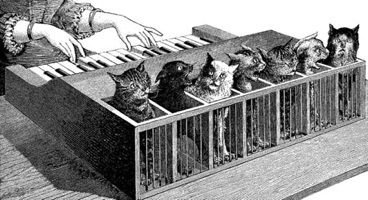
Techno Music and the Cat Piano: Everything New is Old Again

Cat Piano, 1883.

Cat Piano, 1883.

I love tech, and with each day it seems that we see something cool and totally new. But then, sometimes I run across things that remind me that some things we think are new started a long time ago.

This time around, the reminder comes courtesy of John Glassie in A Man of Misconceptions: The Life Of An Eccentric In An Age of Change. The book is a biography of Athanasius Kircher, a Jesuit priest and scholar who lived and worked throughout Europe in the turbulent 17th century. Kircher is a fascinating and eccentric guy. He was a linguist and natural philosopher (what we now call a scientist) working in the turbulent dawn of the scientific revolution. He was on board with the notion of measurement and observation-based science, yet so steeped in traditional explanations of physical and medical phenomena that he never really committed to either one fully. He did some genius stuff, but also got many things completely wrong.

What surprised me, though, were two things that he developed in the 1640’s: a technological music composition system and the cat piano. And here I thought these were both invented to be used for today’s top 40 radio…

Read the full post »

My Joy for the Week: Welcome Fresh Pressers!

I just wanted to take a quick sec to welcome all of you new visitors to Rewiring Virtue. My guess is that many of you happened across this blog at Freshly Pressed. Thanks for taking the time to jump over and take a read. I hope you decide to follow!

In my previous post, I wrote about disappointment. But the last few days have been nothing but joy. It has busy here at Rewiring Virtue, and I am endlessly thankful to WordPress for including me in their Freshly Pressed list. It has been a blast to jump around and check out the blogs of all you visitors.

So, thanks all! Your comments have been great and your likes appreciated.

I hope to see you again soon!

My Disappointment for the Day: News, Steve Jobs, and Plato

Yesterday started out nicely enough. On deck yesterday in my course on Christianity and Media: Plato’s discussions of the arts in The Republic (books 2, 3 and 10) and the First Amendment to the U.S. Constitution. The grandfather of criticism and the great articulation of freedom of expression. The goal of the class was to start exploring different approaches to interpretation of art and media. What does media do and how do we know that it has succeeded? Does good art portray reality accurately, express the emotions of the artist, or teach lessons? Is the First Amendment’s guarantee of free speech and press an unlimited right, or are there times when the right may be legitimately curtailed? My students were great, offering some profound insights and unpacking the complexity of the question.

Steve Jobs and the News

All of that was floating around in my mind as I returned to my office to read the tech news. Of note was a Reuters report about the “civil lawsuit brought by five tech workers against Apple Inc, Google Inc, Intel Corp and others, alleging an illegal conspiracy to eliminate competition for each other’s employees and drive down wages.” The companies seem to have agreed not to poach each other’s employees, which seems to be a common practice, but also seems to be illegal. I say “seems” because I’m not a lawyer and am not really able to say for sure. Morally questionable, in any case. But that’s just context, not the point.

Read the full post »